Showing posts with label Christianity. Show all posts

Wednesday, April 8, 2026

Makan Makanan Sisa, Firman, dan Sakramen

Sebuah refleksi dari sebuah bab dari buku Liturgy of the Ordinary (Tish H. Warren)


Makanan merupakan hal fundamental dan rutin yang kita hadapi setiap hari. Dalam satu sisi, kita bisa menikmati makanan, tetapi kerap kali, makanan yang kita makan adalah makanan sisa kemarin yang sudah agak kering di kulkas. Bahkan, dalam hidup kita seutuhnya, lebih sering kita makan makanan seperti ini daripada makanan fine dining yang fancy.

Namun, ternyata makanan yang kita sering anggap remeh ini justru menunjukkan kita kepada esensi liturgi, terutama Firman Tuhan dan sakramen.

Saya mengajak kita fokus kepada subtext dari bab ini, yaitu Firman, Sakramen, dan Makanan yang Dipandang Remeh. Ada satu benang merah yang kita bisa tarik dari ketiga poin ini:

1.       Firman

Firman Tuhan memberi hidup dan membangun iman, salah satunya lewat pointing out dosa kita dan menegur kita. Dalam hal ini, Firman digambarkan sebagai makanan rohani.


2.       Sakramen

Di dalam gereja, terdapat dua sakramen, yaitu baptisan dan perjamuan kudus.
Keduanya adalah Firman yang dibuat kelihatan dan bisa dirasa (dimakan, diminum, disentuh, dialami secara fisik). Jadi sakramen itu ibarat Firman yang “diinkarnasikan”, bukan hanya masuk telinga (seperti khotbah), tetapi juga masuk tubuh.
“Manusia hidup bukan dr roti saja, tetapi dari setiap firman yang keluar dari mulut Allah” (Matius 4:4).

3.       Makanan yang Dipandang Remeh

Ini seringkali kita temui sebagai makanan kita sehari-hari. Kelihatannya remeh, tapi makanan sehari-hari inilah yang justru membentuk sel tubuh kita, membuat kita kuat utk beraktivitas setiap hari, dan memberikan nutrisi bagi kita. We are not built on fine dining courses, but on water and rice. Ini bagai pasien yang datang ke dokter dengan penyakit ringan, let’s say batuk pilek. Seperti banyak pasien di jaman sekarang, mereka datang ke dokter dengan sudah membawa bekal ilmu dan self diagnosis dari Google. Maka, ketika mereka datang ke dokter, mereka langsung dengan “jitu” meminta obat antibiotik ini itu. Ketika dokter berkata bahwa obatnya sebenarnya hanya banyak istirahat, minum air, makan bergizi, mereka menjadi kecewa. Krn itu adalah hal-hal yang biasa-biasa aja. Sepiring nasi adalah hal sederhana, biasa saja, dan kita tidak sadar ketika memakannya, tetepi tanpa hal itu, kita tidak bisa hidup setiap hari. Sedangkan fancy restaurant foods itu special, memorable, “rhema”, tetapi justru bukan yg sustain buat hidup sehari2.


Firman & sakramen itu sperti air putih, nasi, dan roti. Yesus memakai roti dan anggur, untuk perjamuan terakhir-Nya yang melambangkan diri-Nya sendiri, sebuah hidayngan yang sangat sering dinikmati di jaman itu. Dan siapa itu Firman dalam daging? Yesus! Yesus  ke dirinya sendiri sebagai roti hidup dan air hidup. “Akulah Roti hidup, barangsiapa datang kepada-Ku, ia tidak akan lapar lagi (Yohanes 6:35)”. Yesus menggunakan makanan untuk mendemonstrasikan kematiannya dan juga menggunakan  makanan sebagai pengingat kematiannya. “Hai kamu semua yang haus, marilah dan minumlah air” (Yesaya 55:1). Di 1 Korintus 3:2, Paulus juga membandingkan pengajaran Allah dengan susu dan makanan keras. Bukan karena Firman & sakramen itu kurang wah, tetapi karena keduanya itu: cukup, setia, dan menopang hidup. Terkadang kita bosan membaca Firman Tuhan, dan tidak setiap hari kita membaca Alkitab sampai menangis dan bulu kuduk berdiri, tetapi itulah nasi. Kehadiran Firman & sakramen itu subtle, tidak berasa spesial, tapi ternyata aku bisa hidup selama ini ya karenanya. Pendeta Jethro Rachmadi memberikan analogi mengenai musik dan cara Tuhan bekerja yang sangat indah, yaitu seperti seperti garam. Dan saya rasa Firman dan sakramen dapat digambarkan dengan hal yang sama juga. Ketika kita makan kentang goreng kita pasti bilang “kentangnya enak ya”, dan bukan “garamnya enak ya”. Karena kehadiran garam itu tidak norak, melainkan subtle. Kehadirannya mungkin tidak berasa spesial, tetapi ternyata aku bisa hidup dan menikmati hal-hal lain di sekitarnya selama ini ya karenanya.


Kita sekarang kontraskan ini dengan fancy foods. Fancy foods itu ibarat KKR, natal akbar, momen spiritual yg emosional & rhema. Semua ini tentu tidak salah, dan amat sangat baik. Tetapi ini bukan menu harian kita dan tidak bisa terus menerus jadi sumber kekuatan iman kita. Kalau iman dan kasih kita kepada Kristus hanya berkobar di waktu2 yang wah, kita pasti akan mudah kecewa dan runtuh saat badai kehidupan dan pencobaan datang, dan kita merasa Tuhan tidak sedang bekerja saat hidup terasa biasa. Ibarat pasien di analogi kita tadi yang sudah terlalu sering minum antibiotik, sehingga dia menjadi resistant (kebal) terhadap pekerjaan Tuhan yang biasa-biasa saja. Bahayanya, kalau kita kenal Tuhan kita, Ia adalah Tuhan yang sering bekerja lewat cara yang biasa-biasa aja, melalui orang yang biasa-biasa saja, di tempat yang biasa-biasa saja. Pendeta Billy Kristanto pernah berkata, jangan sampai kita sisipan dengan Tuhan; kita pingin terus di atas, merasa wow, luar biasa, diangkat ke atas. Sedangkan Tuhan kita malah ingin turun ke bumi, belusukan & grounded. Akhirnya kita tidak peka akan kehadiran Tuhan dengan antribut ini.


LEFTOVERS (MAKANAN SISA)


Leftovers bukan makanan gagal. Ini hasil dari kecukupan dan kelimpahan anugerah Tuhan yang cukup, sederhana, tapi ada setiap pagi bagi kita.

Makanan sisa adalah anugerah Tuhan yang berlanjut dan senantiasa ada; disimpan, dijaga, dan dimakan lagi. Relasi Tuhan dengan kita tidak cuma satu kali penyembuhan atau calling pada saat pertobatan, tetapi Ia mau relasi yang personal dan berkelanjutan dengan kita. Ketika ujung jubah Yesus dijamah oleh wanita yang sudah lama sakit pendarahan, Tuhan tidak berkata “ya sudah, pergilah, kamu sudah mendapatkan penyembuhan dari penyakitmu yang kronis bukan?”, tetapi Tuhan berpaling dan bertanya “siapa yang memegang jubah-Ku?” Di sini, Tuhan menunjukkan bahwa Ia tidak ingin relasinya berhenti di penyembuhan saja, melainkan adanya continual personal relationship dengan orang itu setiap hari. Perjalanan kita dengan Tuhan setiap hari ini lah yang lebih penting daripada satu momen penyembuhan yang wah itu.


ROTI MANA: TIDAK BOLEH ADA MAKANAN SISA?


Kalau kita tarik perihal makanan sisa ini ke roti mana yang Tuhan berikan pada bangsa Israel di padang gurun, mungkin kesannya terbalik: Tuhan malah berkata ke bangsa Israel untuk tidak mengambil roti mana terlalu banyak sehingga tersisa untuk keesokan harinya. Ketika bangsa Israel mengambil lebih banyak daripada yang diharuskan, keesokan harinya Tuhan membuat mana mereka menjadi basi. Poin dari cerita ini bukan menganggap negatif makanan sisa, tetapi lebih fokus ke percaya dan beriman terhadap pemeliharaan Tuhan setiap hari. Meskipun kerap biasa saja, tawar, kesannya hambar, tetapi itulah pemeliharaan Tuhan yang cukup dan setia setiap hari. “Sesungguhnya Aku akan menurunkan hujan roti dari langit bagimu tiap-tiap hari” (Keluaran 16:4-5).


PENGETAHUAN ATAS ASAL MUASAL MAKANAN


Kita sering menganggap makanan sehari-hari kita sebagai komoditas yang harus kita konsumsi saja, tidak ada arti dan tidak ada pesan moral. Kita mengkonsumsinya tanpa peduli dari mana bahan baku ini berasal, proses memasaknya, dan nutrisi yg kita dapatkan. Mungkin saja mi instan yg kita makan ini kurang gizi, atau makanan yg kita beli ini bahan bakunya berasal dari penganiayaan terhadap hewan, misalnya foie gras. Foie gras adalah liver angsa/bebek yang diambil dari liver hewan yang membengkak. Pembengkakkan ini disebabkan hewan yang digelontorin makanan secara paksa ke tenggorokannya sebelum hewannya disembelih. Hasilnya, foie gras memiliki cita rasa yang gurih, berlemak, dan sangat nikmat seperti sumsum tulang. Ini mirip kita yg mengkonsumsi teologi global, tanpa moralitas, tanpa Alkitab. Mungkin sebagai orang GRII, kita merasa kita kebalikannya dari ini; Alkitab kita kupas habis, kita adakan eksposisi, namun kita juga sama saja dengan orang yg tidak peduli asal muasal sebuah makanan, karena Tuhan tidak mau kita hidup hanya sebagai konsumen: konsumen teologi, konsumen knowledge, yang semuanya kita kerjakan untuk memenuhi otak kita. Kita dan kembali ke kita lagi. Tetapi Tuhan mau kita menjadi seorang penyembah dan representasi gambar dan rupa Allah, sebab kita dicipta untuk mengenal, menikmati, dan memuliakan Allah.


LITURGI


Hari ini kita fokus ke dua liturgi di ibadah:

1.       Firman: spiritual (pendengaran)

2.       Sakramen: bodily (fisik)


Tetapi kita juga berbicara tentang esensi dari liturgi itu sendiri. Liturgi bisa terasa biasa saja, kaku, dan itu-itu lagi, tetapi liturgi membentuk kesetiaan, bukan sensasi. Ibaratnya, liturgi ibadah menyiapkan kita untuk menghadapi hari biasa, Senin-Sabtu, dan bukan hanya untuk hari Minggu saja, untuk natal saja, untuk paskah saja. Liturgi yang diulang-ulang akan membuat iman kita kuat dan tidak rapuh.

Saya akan mengakhiri dengan satu ayat tentang kesetiaan Tuhan yang luar biasa bagi kita setiap hari, lewat hal-hal yang biasa-biasa saja, yaitu dari Ratapan 3:22-23, “Kasih setia TUHAN-lah yang membuat kita tidak binasa, sebab belas kasih-Nya tidak pernah habis. Setiap pagi kasih itu selalu diperbarui; besar dan teguh kesetiaan-Nya”.

Great is Thy faithfulness!

Friday, November 8, 2024

The Faces of Love

The Faces of Love

By: Angie Wiranata

November 8th, 2024


At world’s end

stood I with grief

and lump on my throat:

Has life no trace of love,

has Sheol erased His name?


Alas! Two things too wonderful to me;
three I do not understand:


Her hand, a mother’s wrath,

           Her sorrow ran so keen,

           Then wept, she healed her child,

           With tears to mend his skin


A father’s trade by day,

           By night a bread he blazed,

           A smile to make a home,

           A smile the eyes ungrazed.


A friend who bore the blame,

           And gave his life in kind,

           For him who dealt the wound,

           Yet had no right to boast.

           He stood to shield his own,

           With heart so pure and blind,

           To guard against the guilt,

           He who deserves it most.


What wonder, what beauty!

For love to be free,

to feel, conceal, and heal,

to use, abuse, and bruise,

yet love forever holds

a value more than life,

a weight worth more than gold.

What wonder, what beauty!

For love be clothed

With martyrdom,

and grief-kissed skin.


Marvel! Marvel!

For have thee not heard:

That no plum unstoned,

As no rose unthorned,

As no bird unboned?

Yet, was it not stone,

which plum may be?

And was it not thorn,

The guard of its bloom?

And was it not bone,

That sets a flight to wing?


At world’s end

I stand as I behold:

‘tis love’s scarred face;

Whom once I know of,

now here I have known:

for who could fathom,

for who dare capture

the faces of love

and His lonely offices?


Fin.

Tuesday, September 17, 2024

If an all-knowing God evil have already decided who goes to heaven and who goes to hell, then is there no free will? Did He then create hell, evil, and suffering? Does that mean that God is not good?

Brilliant question! I asked this question a long time ago and I’m more than happy to share the answers I got with you.

What you’re asking is the classic ‘problem of evil’. From how you deliver your question, I sense that you agree that a good God would be a God who allows free will, and you’re absolutely right. God loves us so much that He gives us free will, so if I were to love Him, it’s because of my free will and not because He forces me too. But if we are truly free to love Him, then we are also free to hate Him. This is evil and it is what causes pain and suffering. So, God did not create evil and pain, but they are ‘necessary possibilities’ of our free will. Ever heard the term ‘rules are meant to be broken’? That’s actually a very theological statement, because just by having a good God would mean that it creates the possibility to rebel against this good God and thus cause evil. God did not create the evil, it was I who freely choose to rebel against Him. This is evil, this is hell. Think of it like the statement ‘darkness is merely the absence of light’. And so, light can exist without darkness, but darkness cannot exist without light. Similarly, evil cannot exist without us having a good God. But do you know understand how this statement could make sense without the fact that God did not create evil? Btw, this is why the definition of hell is not just a hot oven / fiery furnace, but a place where God does not exist, where there’s not a single speck of goodness. This is the ultimate pain and suffering anyone could go through.

Now that we have solved the problem of evil. Let’s move on to your next classic question of predestination vs free will. Predestination means God having already decided His chosen ones because He’s an all-knowing God. God’s sovereignty over predestination is often collided with our free will, and it’s natural for us human to think of it as this either-or way. However, the answer is both: He is both predestines and He allows our free will to decide the course too. How can these two work together simultaneously?

First, God created me to be good. But because there’s goodness and free will, it’s possible for me to rebel against him and I did. So now, by default, my heart’s tendency and motive are all tainted by sin; it is now my ‘default phone setting’. Unless God interferes and saves me by His grace, I would just drown in hell because of my own action. Yet, God sincerely desires for us to ALL be saved. But He can’t just drag us all to love Him, because a forced love is just r*pe. So all God can do is to throw out the ladder of salvation to us, that is His begotten Son; whoever grabs the ladder lives, whoever chooses to not grab the ladder will perish. And God cries when another soul refuses His invitation of salvation and even crucify His begotten Son. He knew all of these are going to happen even before He created the world. He knew He was going to create us, allow us free will, and that we will break them, some would accept Him back and some not. He even knew then, that there are those who will question His actions like me, like you. But this is what breaks my heart: even then, He already prepared the antidote: ‘Himself’. And as a living sacrifice to save us, His begotten Son experienced hell (the absence of God the Father) for us, which is a state worse than death.

Now if I ask you, “are you saved?”, you may answer “I don’t know if God predestines me to be saved or not”. But if you decide to take hold onto the ladder, that is in His Son, Jesus Christ, then your answer would be “I don’t know what God knows, but what I know is I believe in Him, so my sins are all in His hands, my debt is paid, and I have a good God who promises me that I will be with Him through eternity”. God did His part, He threw the ladder to you. Now will you take the ladder?

Alice

Saturday, October 22, 2022

May You See God's Light - A Blessing

May you see God's Light on your path ahead,

As you walk along the valley of the dark,

You shall fear no foes, as you journey on,

As you tread into the night.

May the strength of the Lord never dims and ever sure,

Sure as the dawn at day, and the stars at night. 


May His mercy shine, His grace unto you,

Those who bless you love you, these blessings on them fall.

In your house, His Spirit ever dwells,

And brings you peace and love.

May faith never falters in trials and despair,

May comfort naught be far and help be nigh. 


May His Light shines through, through your life, your ways,

May His sacrifice, be your sacrifice alone,

May the things He loves be dear in your heart,

May His will be ever yours.

As hope of a new year, hope shall you on His Word,

His promises will never, will never shake. 


May you see God's Light on your path ahead,

As you walk along the valley of the dark,

You shall fear no foes, as you journey on,

As you tread into the night.


A blessing for a special someone.

22 October 2022

Tuesday, April 27, 2021

Christmas Tree, Santa Claus, December 25th...Paganism? - Rev. Jethro Rachmadi

Our discussion today is on three Christmas-related matters that Christians find greatly controversial. The first one being Santa Claus, the second on Christmas treehaving no connection whatsoever with Nativity, obscuring and tainting the true meaning of Christmasand the third and most recent case, the December 25th dating system, which originated from pagan European beliefs during the 1st century onward. For example, the cult of the sun during the Roman Empire is believed to determine the dating of December 25th (Sol Invictus). Thus, based on the said arguments, Christians argue that such a paganistic dating system should be disregarded. Or should we?


DISCLAIMER

Today's discussion is not intended to attack the opposing argument. It is never our objective to observe how others reason, but how we reason. Let us remember to carry such a state of mind as we begin our discussion. Today, I would like us to understand that the issues are far more complex than they seem on social media and the articles we read. Today's discussion should allow us to be still and meditate on how this discussion may impact us, instead of blasting it on social media with the pride of knowledge. As a disclaimer, we pursue not the answer to whether Christmas trees and Santa Claus are permissible or not. If shortly we find out that the December 25th dating and Christmas trees are products of Christianity-baptized pagan cultures, this will not and should not shake our faith. I have previously discussed on another occasion the use of the term evangelism and how it is derived from the word Evangelion (Roman), which means the good news of the birth of a new Roman emperor. The term, Evangelion, being more than just a historical term, is very much actually a religious and pagan term, for the emperor was considered the highest among gods. Yet to our surprise, the Bible has never avoided the term Evangelion despite its origin. If the Bible disregards the stigma of using pagan cultures or elements for the sake of the gospel, our view should be the same in terms of Christmas tree or the dating of December 25th. In fact, I do not completely believe December 25th to be the exact date of Christ's birth anyway.

Ω

DECEMBER 25TH

The dating of December 25th is claimed to be originated from the pagan calendar of Sol Invictus (the invincible sun, a cult of the sun sect of the Roman Empire. Aurelian, a Roman Emperor of the year 270-275 AD, dedicated December 25th particularly to worship the sun god in a temple. So, December 25th is just a title we give as opposed to the actual birth date of Christ. But is the claim that such dating is adopted from paganism true?

My material today is based on Thomas J. Talley's "The Origin of the Liturgical Year". Talley discovered that the claim that December 25th is of pagan origin in the 17th-18th century, because of the scholars named Jablonski and Hardwin. Both scholars used this data to support two different ideas. Jablonski wrote, "see how the Christians have compromised and begin to adopt pagan dating, therefore we must avoid the date December 25th". On the other hand, Hardaway wrote, "see how the Christians and the church contextualize with the local culture without causing herself to be unclean". Talley observed that this culture does not originate from the church fathers, yet in both of these scholars' writings, we capture one common idea; the specialty of the date December 25th.

The use of the date December 25th began in 45 BC (Before Christ), during the reign of Julius Caesar (according to the Julian calendar), when the date December 25th was marked as the winter solstice. Winter solstice is a solar equinox, a day when the duration of day increases as compared to the duration of night. As the day shortens, we would not have 12 hours of day and 12 hours of night, but perhaps 11 hours of day and 13 hours of night. By then, the winter solstice was a significant phenomenon in astronomy, but not in religion. Not until Aurelius Caesar set that particular date in Rome as a date to worship the sun (Sol Invictus) in 274 AC (After Christ). We then later discover that the first record of Christmas being celebrated on December 25th was in the year 336 AC. It is clear that the date December 25th was first used for religious purposes during the era of Aurelian and that Christians adopted it afterward.

This is the data which we obtain from Jablonski and Hardaway, but Talley discovered one other fact: between 45 BC and 274 AC, the date December 25th was no longer used for the purpose of Sol Invictus or any other religious purposes. In fact, it was written on the walls of the two Roman temples before the era of Aurelian, and that the dedication towards Sol Invictus was celebrated on August 9th and 28th anyway, instead of December 25th. So, December 25th paganistic significance must have occurred after the era of Aurelian. Such was Talley's first discovery.

Second, he discovered the difference between the celebration and the dating calculation. True that Christians first celebrated Christmas on December 25th in 336 AD after the era of Aurelian, yet the question that Talley raised was whether or not Christians have used the December 25th dating before Aurelian set the date as Sol Invictus in 274 AD. Could Christians have used the December 25th dating before Aurelian's era, but not the Christmas festival? If we could prove that Christians have done so before Aurelian did, we may then claim that Christians did not adopt this dating system from paganism. It turns out that Talley found out that both the eastern and western churches, the churches of Alexandria or Constantinople have attempted to calculate the birth date of Jesus before Aurelius did, which was in the 2nd century (Aurelian's dating was in 274 AC, which was equivalent to the 3rd century).
This fact is well-supported by textual evidence. In the year of 170-20 AD, before Aurelius commented on the book of Daniel, Hippolytus said that God was born in Bethlehem 8 days before the Kalends of January (December 25th). This is interesting because the calculation was done by the western church, while the eastern and western churches date Christmas differently. The eastern church, which we know today as eastern orthodox, considers January 6th or 7th as Christmas day, which has also been proven to be calculated before the Aurelian era. This was written by Clement of Alexandria, a bishop, from the book The Stromata / Miscellanies, according to his discovery in the year 200 in his very own eastern church. We now know through textual evidence that Christians have calculated the dating of December 25th despite not celebrating it. But why did they not celebrate it? Because interestingly, their attempt to calculate one's birth date is merely to point to one's death and resurrection days. This is because, for the church in the 1st, 2nd, and 3rd centuries, the most fundamental day for Christianity is not the birth of Christ, but His death and resurrection. Knowing this fact, they began to wonder if they could too calculate one's birth. Their initial purpose was so they could celebrate good Friday and easter, it was much later that they began to calculate Christ's birth date as well.
This is the reason why there is a discrepancy between the date calculation and the celebration. During the era of Tertullian in 155 AD (before Aurelian), the western church set Friday, March 25th in 29 AD as the date of Christ's birth,  while the eastern church on April 6th in 29 AD. These calculations yield the dates December 25th and January 6th. Calculating one's birth date by figuring out one's death day is a concept called integral age in Judaism. This is not based on the Scripture, but merely on how people think at the time. They also had a belief that the great prophets died on the same date as the date they were conceived. So, they set March 25th as the annunciation day (conception day), because they believed March 25th was the day Christ died. Add 9 months from the conception day, you would have December 25th. The eastern church held the same belief: Adding 9 months to April 6th would give us January 6th. 

In conclusion, the main purpose of this study is not a matter of historical accuracy. We merely attempt to find out whether December 25th is derived from a Christian-baptized pagan culture. Yet it is not the case according to Talley's research, for such calculation has been dated to be conducted prior to 274 AD, although the celebration was held afterward. Therefore, it could be concluded that Aurelius was the one who adopted the date from Christians and not vice versa.

In the present-day context, we need to learn that such claims are mere hypotheses. The point of all this discussion is not so we hate Jablonski and Hardwin, to support Talley, nor to mock the pagans for adopting our date. We have just seen the data and our theses may differ, this is called science, and science grows. Through this discussion, we do not wish to decide which date is correct. What we wish is to learn the reason behind labeling such dating as pagan or as Christian. All the hypotheses which we have just discussed will continue to grow in time. We should not be satisfied with either conclusion A or conclusion B, and that we have to ceaselessly learn different interpretations. This is the true definition of a reformed church, semper reformanda, consistently re-form-ing. If one day, there is another Biblical teaching that rather opposes that of Calvin's, we must be bold to refrain from Calvin. Our heart is constantly in search of one sole unchanging individual, one sole unchanging theory, but this is the very Roman Catholic principle which Luther was against. Taking hold of tradition without having a reforming heart is not being reformed after all. We have to constantly evaluate and correct our interpretations.


CHRISTMAS TREE

Some Christians often sneer at the sound of Christmas Trees and Santa Claus for they have the danger of shifting us into idolatry. This is based on realistic reasoning for it may indeed fade away the true meaning of Christmas. We have witnessed this in the world of commercialism, how people around the world, regardless of their beliefs, may celebrate Christmas without having anything to do with Christ, and by so have drifted us away from the true meaning of Christmas.

First of all, what is idolatry? Which should we consider an idol and which should we not? Being raised such a question, our mind would often be focused on the object which may be associated with idolatry, for instance for us Indonesians, the ash of Mount Kawi. Regardless of its user, the ash itself holds a mystical sense of idolatry. Or try to make sense of the following sentence: An idol is something good, in fact, the better something is, the more prone it will be to become an idol. We even focus on the object in the previous sentence, and not on its user. Today, I would like you to see how the image of idolatry is not as simple as observed in light of the Biblical paradigm.

Tuesday, September 8, 2020

Bodily Worship: Ordinary, Repetitive...and a Life-Changer - Rev. Jethro Rachmadi

PREFACE

This sermon note is an excerpt from a sermon series entitled Bodily Worship by Rev. Jethro Rachmadi on the account of online worship. As the world is partly shut down due to the pandemic, churches around the world find a solution in technological aid to continue religious services. And for some people, such abnormality might even be considered a more efficient way of worshipping and should therefore be the post-pandemic new normal of worshipping".

By addressing this issue, we do not by all means force or promote shaming towards those who choose not to come to bodily services during the pandemic, because some congregants may live with elderlies or juveniles, doctors or nurses, or simply would like to be more cautious for themselves.
Our sole purpose in addressing this issue is to acknowledge that online worship is an inevitable abnormality that we must all hope and pray to return to normal bodily worship.

This is the fourth session of the Bodily Worship series. Previous sessions talk about how liturgy exists inside and outside of the church gate and how liturgy takes a big role in shaping the hearts of men. Though ordinary, liturgy is a double-edged sword that powerfully and actively changes its doer down to men's most inner desire. We know that the heart reflects men's desire, but it's almost as important to remember how the heart also plants men's desire. After all, we are what we desire, or more relationally, Who we desire.

For more information on the prior sessions, please click on the link below:

Bodily Worship #1: https://griikg.org/bodily-worship/
Bodily Woship #2: https://griikg.org/bodily-worship-2/
Bodily Woship #3: https://griikg.org/bodily-worship-3/


Ω

BODILY WORSHIP: ORDINARY, REPETITIVE...AND A LIFE-CHANGER

1. The Derision towards the Ordinary

Our Lord works through ordinary things. You might have even heard of this parable of a city that was drowned in a big flood. A man sought safety on the roof of a house, as he prayed, "Lord, have mercy on me and be quick to save me!" Not long after, a man in a wooden boat rowed towards him as he offered a seat on his boat. But the man shook his head saying, "Sorry, sir. I've prayed to God to save me. He will be the one who saves me". And so the wooden boat left him. Soon after, a navy boat approached him and threw a rope towards him, but the man rejected the rope for the same reason. Finally, a helicopter hovered above him and with a loud voice a soldier cried, "Sir, take hold on the ladder, we will pull you up, the water has reached your neck!" But the man replied, "No, sir. God will be the one who saves me Himself". At the end of the day, the man died and went to heaven. He asked God why He did not save Him, and God said, "I sent you a wooden boat, a navy boat, and a chopper, but you refused. You waited for an extraordinary rescue, while I work through the ordinary."

Romans 10:17 says that "[...] faith comes from hearing, and hearing through the Word of God", but let us go back to its preceding verses, "and how are they to hear without someone preaching?" (verse 14b). Someone preaching the Word is an ordinary act. We constantly expect spectacular repentance testimonies. Honestly, nobody wants to hear, "I came to believe in the Lord Jesus by reading the Bible for 20 years, or by coming to the Sunday School diligently as a kid." The story that we want to hear is of a murderer who repents. But even when we study such extraordinary testimony, there is always an ordinary matter that we missed. Say that murderer repented because when he was imprisoned, he happened to find a piece of small paper that happened to be torn from a Bible. But surely somebody had to first bring a Bible to the prison, somebody else had to print the Bible and somebody had to translate it to another language. And how are they to hear without someone preaching?
When we go to a doctor's appointment, nobody wants to be prescribed you just need enough rest, some vitamin C, exercise regularly, and don't forget to hydrate. What we wish to hear is us needing a super dose of vitamin C or other extraordinary solutions.

Finally, have you not noticed that it is through ordinary things that the God we know in our Bible creates the most extraordinary things?

Saturday, May 2, 2020

The Reason for Suffering - Pdt. Jethro Rachmadi

Kita sering dengar pertanyaan, "kenapa sih Tuhan kasih COVID-19 ini?", dan kita sering resah untuk mendapatkan jawabannya. Kita harus berhati-hati dengan menuntut jawaban terhadap semua pertanyaan-pertanyaan kita. Kadang, kita nggak harus mengetahui segala sesuatu.

Memang, Tuhan tempatkan banyak beautiful things di dunia ini untuk kita ketahui dan pelajari. Dia kasih kita Taman Eden. Tapi juga ada hal-hal yang kita tidak perlu ketahui, seperti rasa buah pada pohon pengetahuan yang baik dan jahat itu.
Inilah perbedaan antara bijaksana dan inteligensi. Kalau kita pintar secara inteligensi, kita tau banyak hal-hal. Tapi kalau kita bijaksana, kita akan dapat menerima kenyataan bahwa ada juga hal-hal yang kita nggak harus ketahui, karena hal-hal tersebut di luar hak kita untuk kita ketahui, dan kita nggak akan pernah bisa mengerti secara penuh anyway (seperti contohnya kebesaran Tuhan).
Bahkan sebagai orang Kristen pun, kita sering menuntut harus tau ini itu. Ada orang-orang yang ke gereja hanya untuk cari kemakmuran, ada pula orang-orang yang ke gereja hanya utk cari kepandaian, apa bedanya?? Tidak ada!
Bersyukurlah kita, kalau kita tidak bisa mengupas dan mengerti Tuhan kita secara 100%, karena itu artinya bijaksana Tuhan kita jauh lebih besar daripada kita.

Seperti jawaban Tuhan kepada penderitaan Ayub, terkadang kita tidak perlu tanya alasan di balik sesuatu, tetapi yang penting adalah apa tujuan di balik semua ini dan apa yang kita bisa lakukan lewat peristiwa ini. Itu pertanyaan yang jauh lebih penting. Dalam kasus Ayub, jawaban Tuhan adalah: Lihatlah binatang-binatang Behemoth dan Leviathan (mythological creatures), mereka sangat liar dan tidak bisa dijinakkan. Sama seperti bagaimana kita tidak bisa menjinakkan Tuhan.
Daripada bertanya "kenapa Tuhan timpakan ini kepada aku?", mungkin kita bisa belajar bertanya,  "apa yang Tuhan mau kerjakan melalui ini?". Instead of melihat ke masa lalu (bertanya kenapa), lihatlah ke masa depan (untuk tujuan apa).

Ketika murid-murid Yesus bertanya kepada Yesus di Yoh 9:1-41, "Rabi, siapakah yang berbuat dosa, orang ini sendiri atau orang tuanya, sehingga ia dilahirkan buta?", "Bukan", jawab Yesus, "tetapi karena pekerjaan-pekerjaan Allah harus dinyatakan di dalam dia."

Memeluk kenyataan bahwa kita tidak bisa dan tidak harus tau segala-galanya juga menandakan adanya trust (kepercayaan) kepada Tuhan. Ini sangat beautiful. Seperti di dalam relasi cinta, jika kita mencintai seseorang, dan kita tau bahwa orang itu juga mencintai kita, akan terdapat trust diantara saudara dan pasangan saudara. Saudara bisa trust, bukan karena saudara telah mengetahui segala-galanya tentang pasangan saudara, tetapi justru karena saudara belum mengetahui semuanya. Dan ini sangat beautiful, karena love is trusting in the absence of knowledge.

2 Mei 2020

Catatan renungan ini belum diperiksa oleh pengkhotbah.

Tuesday, April 21, 2020

Love in Light of the First Law of Thermodynamics

I often attempt to explain how the disappearance of love's excitement does not imply the love's insincerity. We often accuse love for not being genuine because the spark is no longer there, the butterfly in the stomach gone.

I like to use Newton's First Law of Thermodynamics as a model to explain this phenomenon, which states that energy can neither be created nor destroyed; energy can only be transferred or changed from one form to another.

NOT DESTROYED

Yes, the euphoria of juvenile love diminishes as we mature in relationship. Although we very much enjoy each other's company, we lack the excitement and electric shock we had during out first years.
There is nothing out of the ordinary here; it is as expected. In fact, it could be a sign of growth.

The reason why the first excitement or joy fades away is to give space for a new kind of joy. The new joy does not replace the former joy, but enrich it. You may not feel the butterfly in your stomach anymore, but you have the joy of child-bearing, the joy of raising a child. When the child has grown into an adult, you will yet experience a different joy, that is in watching your children's children grow, and so on and so forth. For who can withstand a constant excitement and euphoria for a prolonged period of time? We would eventually get tired and sick of it ourselves! Like a child who eats too much candy. At first it tastes heavenly, but after days of sucking a lolly, his stomach would start to ache and the last thing he wishes to do is to have another candy.

Love changes from one form to another. When you grow old and grey, you may not possess the spark of youth, for it has been transformed into the strength of mature love, finely tested by time. It is at that moment that you may gaze into your partner's eyes and frames of moments would be projected: the moments when you were there for each other through illness, through adversaries, through disagreements. Yet above all, still you say "I would go through it all over again for you."

NOT CREATED

Back to Newton's First Law of Thermodynamics: "energy can neither be created nor destroyed [...]".
We have talked about the transformation (and not destruction) of love.

But how is love not created?

Thursday, October 24, 2019

Theology & Ecology - Rev. Billy Kristanto & Mr. Sonny Sutanto

Session 1 - Pdt. Billy Kristanto

I. Discouragement

These are several discouragements we commonly face towards the ecological mandate:

1. Eschatological Discontinuity

The eschatological discontinuity is a thought that the new heaven and earth are complete new, in a way that the eschatological heaven and earth have nothing to do with the present ecology. We might have heard people say, "it's OK for this world to be distorted for God will replace it with a new one. If I try to fix the ecology, I will lose against the people who don't care about the ecology anyway".

Lutheran eschatology emphasizes on eschatological discontinuity, unlike Reformed eschatology, though we see both aspects in the Scripture. But we would like to emphasize on our responsibility towards the ecology, because what we sow here on earth—which we believe also as the kingdom of God—will God cultivate and He will reckon our participation if we do all things according to His Word.

2. Platonic Soteriology

The Platonic Soteriology states that we should not care of anything material. The opposite, Theo-Platonic states otherwise, that what matter are the things invisible, spiritual, and not even the physical self. We believe both thoughts are heretical, for we claim to believe in the resurrection of the body in the Apostle's Creed.

3. Individual Redemption (instead of cosmic)

We believe that God’s redemption works towards mankind. However, the idea of an individual redemption is against the notion that the whole creation is being “redeemed” as well. The Scripture says that “[…] the whole creation has been groaning in labor pains until now” (Romans 8:22), yearning for His redemption. We read in Paul’s epistle that he talked of the cosmic redemption, and not mere individual redemption. The human soul, body, as well as the whole creation must be redeemed. This is why we might be familiar with the terms redeemed music, redeemed art, and so on.

4. False Reception of Humankind as the Crown of Creation

Lynn Townsend White Jr. proposed a thesis that one of the ideologies that causes ecological crisis is the Christian belief, because Christianity teaches that we are the crown of creation, hence having the power to destroy nature.
But we know that this is a wrong interpretation of the Christian theology. We must be careful not to twist Christianity to destroy ecology.

5. Modern Cartesian Objectification of Nature

According to René Descartes, we are subjects that think and the things outside the subjects that think are called objects. Men have consciousness to think of the things we thought of. Descartes are not even talking about mere nature, he also meant our physical bodies being objects.

This subject and object relationship is problematic in Christianity. In the Christian theology, we always view everything in relation to each other: the relationship between the mind and the body, the relationship between men and the relationship between men and lower creations.

Descartes objectification seemed as if he was creating a distance that leads us to assess matters objectively. This idea can affect how we treat nature. If you consider your body as mere object, you would us your body the same “way” with the way you use your pen. This is a highly utilitarian thought.

6. Enlightenment: Mechanical View of the World

Descartes lived in the Baroque era, when rationalism and mechanical view of things raised to popularism. The opposite of mechanical view is organic view. For example, in the movie ‘Avatar’, there are men in trees, and trees in men. This idea opposes the mechanical view, but it is also an un-Biblical thought.
II. Encouragement

1. Nature as General Revelation of God

We believe in general revelation and special revelation. What crosses our minds when we discuss of the general revelation is God’ s provision of nature. Then why do we feel terrible tearing off the pages of the Bible, which we believe to be a special revelation, and not feel bad tearing off trees for no good reason?

2. Presence of God (context-sensitive!)

God is present everywhere, even in the most distorted places and false churches. Berkoff stated that because God is omnipresent, He is present in men as well as animals, though His presence are different in men than animals. Alike, God is present in both rightful churches and false churches.
Therefore, we must protect and preserve wherever God may be present! We cannot pay attention to places where we believe God to be most certainly present, like the church, and not care of the wild forest where God seems to be less present.

Tuesday, July 30, 2019

The Ideal Christian Community - Rev. Billy Kristanto

GRII KG Retreat 2019
ACTS - A Community that Serves
26-27 Juli 2019

Session #1 - The Ideal Christian Community (Pdt. Billy Kristanto)


The committee has determined ‘The Ideal Christian Community’ as the title of the first session. However, the search for ‘the ideal’ could dangerously be our idol. We are prone to leave our faith in our failure to find what’s ideal, or worse, we might find what’s ideal and be disappointed with it. There are many things that we cannot choose in this world, like the place we were born and the children we give birth to. When we receive what we do not consider as ideal, we might turn cynical, and worse, indifferent and stoic.

I’m not at all implying that we must escape from the search of idealism, but we must be careful in understanding its concept. The Renaissance art depicts a more ideal picture of life, while the later (or contemporary) art a more realistic idea of life, showing its misery and depressing façade. However, if we are to discuss the idealism of a Christian community, we must begin with how God first called us.

Grace and Growth

God called us as we were. In fact, it doesn’t matter where we start. Jesus started with 2 disciples, and later 12, one of them being Judas. What if this is the Bible’s idea of what’s ideal? Compare this idea with prestigious universities that only accept candidates with high SATs. This is because they do not wish to educate candidates with no intellectual assets.
Without ignoring the fact that of course, we demand growth from the accepted unqualified candidates. Alike, God demands us to grow, and not remain static in faith.
The main challenge is to enter an “unideal church”, to accept the unsettling reality and contribute there.
The book “When Sinners Say I Do” suggests how marriage is about two sinners proclaiming a vow for each other. And this reminds me of when sinners go to church. Theodore Beza said that there is a necessity in men’s fallenness to show God’s sovereignty, wisdom and decree. Though we must be careful with what Beza stated we must agree that God loves the fallen sinners more than He loves the unfallen angels. The beauty is not in the sin itself, for our sins are so very ugly. The beauty is in seeing our ugly sins from the perspective of the love of God.

The Beloved
We need to unlearn the term the children of God. In the Old Testament, the Israelites were called the children of God. When Jesus came, He was called the same, as He acted as the children of Israel (promised Davidic King) and the beloved Son (read of His baptism). However, the story of this so-called the beloved goes a long way back. The Israelites were too called the beloved, but they didn’t acknowledge the love and rebelled. The same story is being told in us today, we are the beloved, but we often act as if we have never received such divine love. The world tells us not of the contemplation of the beloved, but the concept that we need to purchase and earn love through our achievements.

A Love-Driver Service
Our retreat’s theme is ACTS (A Community That Serves), but before even talking about serving, we must first talk about loving, and what precedes loving is being loved. This is the true foundation of serving, for serving without love is futile. Perhaps our service is a mere a self-escape, or a search for a thing or two to do to fill our spare time? Finally, you can serve without love, but you cannot love without serving. Service is an action produced out of love, and hence must all service be love-driven.
Sure, if God could use an inanimate object, a stone, to work for His Kingdom, God surely could use those who serve Him with the wrong motivation. But a ministry done out of love is what’s pleasing to God.

Forgiveness vs. Self-Righteousness

Those who have been pardoned greatly, will act out great love. “Therefore I tell you, her sins, which are many, are forgiven—for she loved much. But he who is forgiven little, loves little” (Luke 7:47). Love is an action. Sure, we cannot escape the affectionate feeling of love, but above all, love must be shown in action. Those who don’t do much, do not love, do not feel loved, and do not consider themselves as sinners, or perhaps they belittle their sins. Self-righteousness disables us to possess the power to love others. The root of not being able to love is the failure to realize the greatness of God’s forgiveness of our sin.
In the 1989 Joint Declaration on the Doctrine of Justification, Martin Luther stated simul iustus et peccator, which suggests that we are at the same time both righteous (as we have been justified) and yet still sinners. Paul did not say “I was the chief sinner”, He said, “I am the chief sinner”.

Union with Christ

When you serve, you serve both Christ and His body. All things done without Christ (Christology) are dangerous. Sermons without mentioning Christ leads to mere moral teaching (although common-grace speaking, moral teachings are better than bad deeds).
Persecutions and sufferings are what unite us with Christ, because like us, Christ has experienced all that. Thus, those who are picky towards what they want to experience, do not live in unity with Christ. Any benefits that we have gained through following Christ (the Head), must we also share with the body.
Calvin Institutes IV.1.3: “It is as if one said that the saints are gathered into the society of Christ on the principle that whatever benefits God confers upon them, they should in turn share with one another”.

Tuesday, May 14, 2019

Jealousy, Idolatry & Fire - Vic. Jethro Rachmadi

This is the third part of our discussion on Deuteronomic Theology. You can read the first and second discussion posts here:
Deuteronomic Theology Part I (Deuteronomic Theology):
Deuteronomic Theology Part II (Deuteronomic History):
http://look-ing-up.blogspot.com/2019/03/deuteronomic-history-vic-jethro-rachmadi.html

Let us open to Deuteronomy 4:15-34
Covenental life is a central topic in the lives of chosen people, and it is an important basis in Deuteronomy. In this part, we will discuss what God means by a covenant. It is important for us to explore this concept repetitively because we tend to extreme our relationship to either side of the poles. A covenant is a covenantal relationship, which involves two or more parties, consisting of both relational and covenantal aspects. Yet we often separate these two concepts in our daily application. When we sign a contract, we assume that both parties do not have any personal relationship. A personal relationship for us consists of freedom and spontaneity and is absent from regulated rules jotted down on a written contract. But the Bible says that a covenant transcends this narrow category. For in Deuteronomy, we see that our relationship with God is so intimate and private, and yet our demands exceed those of a professional contract. Therefore, we must understand our relationship with God along with its complexity.

Moses used three pictures to show this concept clearly. We always connote our relationship with God with love and faithfulness, but in this part of the scripture, we see jealousy, perversion (idolatry), and consuming fire. Through these three points, we will discuss more in depth about our relationship with God.

JEALOUSY

Richard Dawkins claimed that Christianity must be disposed of, because of this annoying "fictional" character described in Deuteronomy 4:21-24. Not only is He a jealous character, but He takes pride in His jealous attribute. Before we move on, we have to be able to differentiate between jealousy and envy. To envy is to covet (egoistic), but to be jealous is to be possessive (also egoistic and self-centered). The difference is that to envy, is to covet something that others own, but to be jealous is to be possessive towards what one owns. Therefore, the Hebrew and Greek Bible use the terms envy and jealousy interchangeably (Hebrew: qannah/qinnah; Greek: zelos).
Is God's jealousy here the same as envy then? Did Dawkins speak of truth? Is God depicted as an annoying character here? Absolutely not. There is a distinct difference in the Hebrew language. Our differentiating tool is phenomena, while the Hebrew's differentiating tool is in who does it. Though based on the same root word, qinnah is used specifically for human (mentioned 32-44 times in the Bible), while qannah is for God (mentioned 6 times in the Bible). The Bible's differentiating tool is not in its phenomena or the jealousy level a person possesses but in the doer. Therefore, we ought not to view God's jealousy as a negative concept. After all, the positivity in our jealousy is very evident. What kind of jealousy is positive? As parents, when we see our children behaving badly, we rise to anger, which is caused simply by our love towards them. It is easier to explain this in the English language because they have the terms for and against. For instance, are you for or against the nuclear plant? When we are jealous of a person, what is important is to ask the question of whether we are angry with that person, or angry for that person.
Anger is not a sin in and of itself, for anger does not collide with a relationship. If you are engaged in a relationship, you will experience anger. If you have never been angry with a person, it means you do not have any relationship with him. The opposite of love is not anger nor hate, but apathy.
Why then does the picture of anger in our daily life so different than the anger Bible depicts? Because we have never seen true love. Being in our sinful nature, our love is stained with self-centeredness, as we love others to fulfill our personal needs. We are often more hungry than being in love. We could love something immensely, but only for us to consume. If you truly love a tree, you would not loot its twigs, fruits, and wood, but you would water it. Therefore, it is impossible for us human to create positive jealousy, because our anger is always because of the object, and not for the object. We rise to anger because their sins humiliate and inflict us.

Thus, the classification is not between envy and jealousy, but in the doer. The aspect of corruptness is ever present when we are jealous, not because there is absolutely no aspect of angry for the object, but because there is always an aspect of anger because of the object.
Yet God's jealousy purely consists of anger for those whom He loves. We must be thankful if our relationship with God is full of God's anger because it only shows how much He cares and loves you. CS Lewis wrote that a God who is never satisfied with you only shows that He is a God who loves you, like an artist who considers his art always lacking and in need of correction. God is never satisfied. Demanding a God who could be satisfied is demanding Him to stop loving us.

Now you have seen how positive God's jealousy is. The drop rate in a theological seminary is the highest among all schools. In my previous accreditation, my professor told me that the drop rate of 20-25% in a theological seminary is very common. But in our theological seminary, there must usually be a mistake or a sin which a dropped out student committed during his study, and very rarely due to health issue problem. And every time there was a student being dropped out, the other students would weep, not because of his sins, but our sins. It did not matter what the dropped out student did, what mattered most was the fact that we were aware of his sins since the beginning and refused to confront him. And we did not confront him not because we fear to offend him, but because we simply did not care. Or frankly speaking, our care towards our own feelings mattered more than our care towards him.
Hence, God's jealousy towards men is a significant declaration. God is very committed to our well-being. This is the first point.

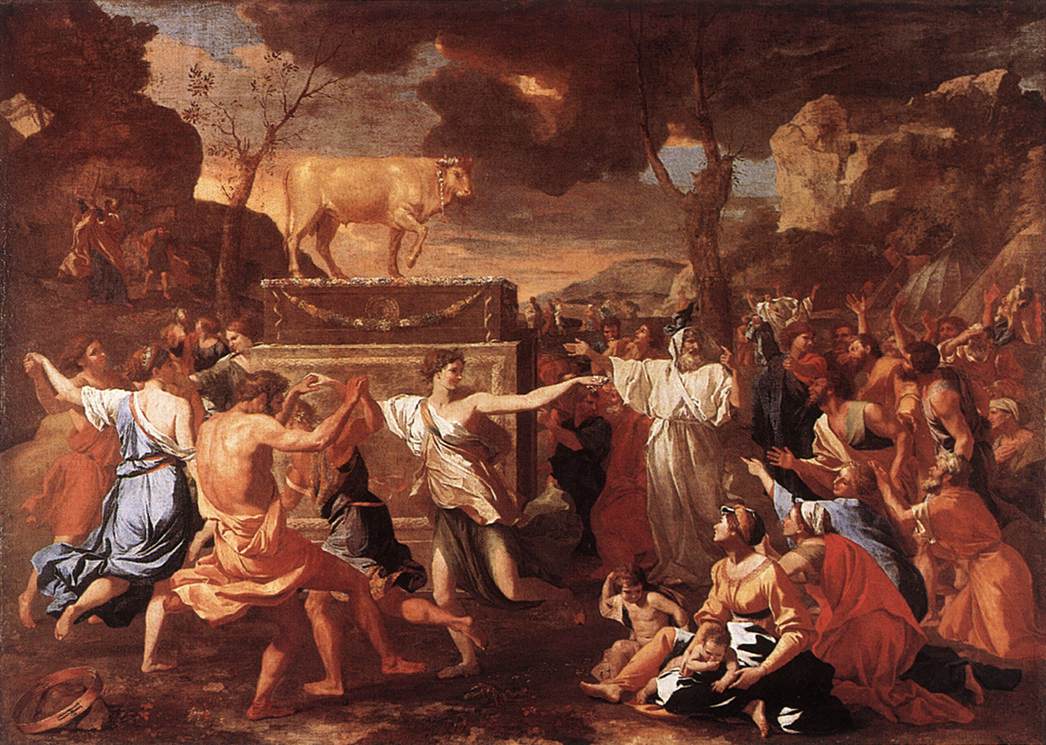
Image result for the adoration of the golden calf
The Adoration of the Golden Calf, by Nicolas Poussin

IDOLATRY

This second point is mentioned frequently throughout verses 15-23. But before we dig deeper into those verses, we have to set one thing straight: verses 16-19 are especially interesting, this part reminds us of what idolatry is. The purpose of these verses is to show what could be considered gods, and the answer is everything! The purpose of these verses is not to instruct what we should not create, but to instruct that we should not create everything from A to Z. Verse 19 gives an interesting definition, "an idol is not just everything, but something that is God-given". Meaning, an idol is actually something good, because all things God-given is good. In fact, it is a good thing that could be transformed into an idol, and the better it is, the better the idol it will make.
For example, in disciplining your child, you remind them not to play video games for hours so that they would be the number one in their class and become an achiever. Yet, according to the Bible, this aspiration to be the number one and to be an achiever could even be a better idol than hours playing the video game. When your child is all grown up, performance and ranking become his life's goal, by doing so, he abandons his wife and children, he belittles relationships that do not benefit him, all these for the sake of his performance. Because when he plays video games, everyone around him despises his action, and he knows himself that his addiction to video games is bad. Contrarily, by becoming a workaholic, many companies would contact him, offering him jobs. Let this be a reminder for us all that idolatry is not in the object, but about where we rank that object within our hearts. Augustine introduced the idea of ordo amoris (the order of love). If we place the object we love higher than God in our ordo amoris, and if it fills our life, replacing God's position, the object has become our idol. Read more about ordo amoris here: http://look-ing-up.blogspot.com/2017/09/a-double-victory.html.
Idolatry is when we consider an object to be most effectual in our lives, including most effectual in creating grief and resentment. Your idol is not only something that delivers you the most joy, but also something that delivers you the most resentment. Your idol is the most effectual object in your life as it places the highest ranking in your ordo amoris.

Sunday, March 3, 2019

Deuteronomic History - Vic. Jethro Rachmadi

Last week Rev. Billy Kristanto delivered the topic on Deuteronomic Theology in our Bible study (click link to read his discussion on Deuteronomic Theology: http://look-ing-up.blogspot.com/2019/01/the-deuteronomic-theology-rev-billy.html).
Today, we will not be discussing only the theology of Deuteronomy, but also its role and effects on history.


INTRODUCTION


We have learned previously that one of the primary themes of Deuteronomic Theology is retribution theology (Indonesian: hukum tabur tuai (the law of sowing and harvesting)). If you are a good person, you will be blessed, if you are a bad person, you will be cursed.
In Deuteronomic Theology, there is a treaty-like format / writing system, which is very much resembles the Suzerain-Vassal Treaty (literally translates to Lord-Servant Treaty). This was a universal treaty format during the ancient time, which provides guidance to writing a treaty, specifically between a lord and a servant.
Here's the format and structure of the Suzerain-Vassal Treaty:

  1. Preamble:
    The identification of both parties bound in the contract.
  2. Prologue:
    What the lord has done so far for the servant (the story so far).
  3. Stipulations:
    The laws and regulations ought to be fulfilled in order for this treaty to be valid.
  4. Blessings / curses:
    The rewards and punishments received by the servant from the lord when the stated laws are fulfilled or neglected.

Interestingly, we could find these exact same four elements in the book of Deuteronomy:
  1. Preamble: Deut 1:1-5
    Yahweh spoke to Israel through Moses.
  2. Prologue: Deut 1:1-11
    The story so far and what Yahweh has done for Israel in the past.
  3. Stipulations: Deut 1:12-26
    The deeds to be done and not to be done.
  4. Blessings / curses: Deut 1:27-34
    The outcomes (blessings and curses) of their respective deeds.
These four elements are not found in any other Pentateuch books. Now that we have seen how treaty-like and retributional the book of Deuteronomy is, we will discuss its effects on history.

The book of Deuteronomy ends the five Pentateuch books, and it also acts as a precursor of a new way of writing, such as the Deuteronomy school and the book of Joshua. Here are some more examples:

  • In the book of Joshua, Israel obeyed God and won battles, yet Achan disobeyed God by plundering forbidden objects and Israel lost the battle. This shows an obvious application of the retribution theology.
  • In the book of Judges, Israel sinned and was damned, and they gained salvation when they repented.
  • In the books 1-2 Samuel, there is too a contrast between Saul and David. Saul sinned and was damned, David was obedient and was blessed. Yet, when David disobeyed God, he too was damned.
  • In the books 1-2 Kings, we see the same repeated pattern of "and he did what was evil / right in the sight of the LORD" and the blessings / curses which follow.
Patterns such as these are not present in the books prior to the book of Deuteronomy.

Therefore, we must view history and read the Historical books (Joshua, Judges, 1-2 Samuel, 1-2 Kings, etc) in light of the retribution theology.


THE TWO VOICES OF THE RETRIBUTION THEOLOGY

The question arises is, "why do these books emphasize so much on retribution theology?"
We are not merely comparing the Old Testament with the New Testament. We are not implying at all that deeds are all that matter in the Old Testament and grace is all the matter in the New Testament.
In fact, there are many occurances when the Old Testament seems to be against Deuteronomic and retribution theologies. For instance, the books of Job, Ecclesiastes, and Psalms 73. It's as if we spot two clashing theologies in the same Bible!
Today, we will focus our discussion specifically to the books of Kings and Chronicles.

Why was the book of Deuteronomy very uplifted and glorified, that more than two-hundred references of Deuteronomy were made in the New Testament?
Moreover, out of all Old Testament references Jesus made, He referred to the book of Deuteronomy the most. Yet it seems that Jesus was questioning the retribution theology several times Himself. When He was asked whether a blind man was blind because of his own sins or his parents' sins, His answer was, "It was not that this man sinned, or his parents, but that the works of God might be displayed in him" (John 9:3). It seems here that Jesus erased the category of retribution. Jesus has also said, "for He makes His sun rise on the evil and on the good, and sends rain on the just and on the unjust" (Matthew 5:45), which the Reformed Theology is referred to as common grace. It might be easy on the ears for us reading this passage today, but for the Israelites at that time who held onto the retribution theology so dearly, Jesus' saying was difficult for them to accept. Even today, retribution theology is our default mode when we come before the LORD's presence, especially if you are a conservative. Similarly, even if you are a good citizen in your country, you would feel a little fear when a cop passes by. And whether it is within our awareness or not, we like to think that it is dangerous to not attend a church service, because we believe God would punish us. Let alone the Israelites who held onto the retribution theology so dearly. They were in shock when they heard Jesus spoke of the common grace theology.
There might be those who consider themselves fugitives, and upon knowing of the common grace, they would find relief. On the other hand, the Pharisees and scribes might think, "if this Jesus proclaimed that retribution theology is invalid, what then is my point in living an obedient life?"

On that account, we could find two different voices in the Bible in dialogue, instead of one singular voice. Imagine watching a play with two characters with two different voices speaking to each other in a dialogue. If we want to get the full picture of the play, we must not listen to only one voice, but to both. Alike, if we want to read the Bible as a whole, we must listen to both voices.

The books of Kings are very affected by the Deuteronomic Theology.
The books of Chronicles, on the other hand, seem to be not affected by the Deuteronomic Theology.
We often think that the books of Chronicles are tedious because it it full of repetitions. Whereas, it speaks with a different voice than the books it precedes.
We will first discuss the books of Kings.


THE BOOKS OF KINGS

2 Kings 21 tells the story of King Manasseh, a king evil in the sight of the LORD. In fact, he was the worst and most corrupt king of the Southern kingdom of Judah, reigning for 55 years, making him Judah's longest reigning king. He was also the first king who did not befriend any king from the Northern kingdom of Israel.
A piece of brief historical information: the Northern and Southern kingdoms split during the reign of King Hezekiah, Manasseh's father. Yet, unfeared by this event, Manasseh continued to blaspheme the LORD.

2 Kings 21 lists down all Manasseh's disobedience, which shows how severely he has disobeyed the Deuteronomic law. He also performed child-sacrifice and consulted mediums. As a result, God proclaimed to bring Jerusalem and Judah to destruction as He did to the Northern kingdom when Israel was exiled in Assyria (2 Kings 21:11-15).
We later know that God's words came true when the Southern kingdom fell into the hands of Babylon, although it happened long after Manasseh's death.

Now we see Manasseh's descendant, King Josiah (2 Kings 23:4-24). Josiah was the best king of Judah, "before him there was no king like him, who turned to the Lord with all his heart and with all his soul and with all his might, according to all the Law of Moses, nor did any like him arise after him" (2 Kings 23:25).
His success in reigning Judah was as a result of his obedience (retribution theology).
However, in verse 26, God said that Josiah's righteousness as mentioned in verse 25, still could not surpass Manasseh's evil, that He would not revoke his curse towards the Southern kingdom, even long after Manasseh's death. "Still the Lord did not turn from the burning of His great wrath, by which His anger was kindled against Judah, because of all the provocations with which Manasseh had provoked Him" (2 Kings 23:26). God still "could not move on" from His anger towards Manasseh for two generations. What caused God's prolonged great wrath towards Manasseh, even long after Manasseh's death? Wouldn't it be the same as saying, "Martin Luther, John Calvin and Zwing Li rose, but God still remembers Pope's sins and because of this reason, churches will still collapse!"?

Now let's slightly change gear to how the same story is delivered in the books of Chronicles.

Saturday, February 23, 2019

Envious vs. Generous - Rev. Billy Kristanto

Today, we will discuss one of Jesus' parables, "Laborers in the Vineyard", from Matthew 20:1-16. We will discuss the parable verse by verse.

Verses 1-2
In this parable, the laborers depict us, while the master of the house depicts the LORD.
In verse 2, the laborers proposed that they were to be paid a denarius for a day of work, and the Lord agreed. Here, the laborers were negotiating in a take-and-give manner with the Lord. Yet, the Lord agreed to the contract and let them work for him.

Verses 3-4
At about the third hour (translated to 09:00 am), we find the Lord going out of his house finding some idle men at the marketplace. Then he asked them to work for him as well, without making any deals with them. The Lord did not say, "work in my vineyard, if you start working at 09:00 am and end at 06:00 pm, you will be paid 75% denarius at the end of the day." But what the Lord told them was, "whatever is right I will give you." In other words, "what I think you deserve, you will receive."
And they did as they were told obediently.

Verses 5-7
Here, we read that the Lord goes out of his vineyard several times to find more workers, showing the LORD's abundant grace for those who are willing to work for His kingdom.
In these verses, the sixth hour means 12:00 pm, the ninth hour means 03:00 pm and the eleventh hour means 05:00 pm.
Despite these men's late start, they were willing to work for him without any negotiation, calculation nor deals with the Lord. They might perhaps think within themselves that they would get one-tenth a denarius at the end of the day (if they begin working at 05:00 pm and ends at 06:00 pm). But they did not speak up to negotiate the deal.

Painting of the Parable, by Jacob Willemszoon de Wet, mid-17th century

Verse 8-10
This part is really important. Why did the Lord pay those who work the latest first? It would make a lot more sense to pay those who work the earliest first.
The question is, what difference would it make if the Lord pays those who work the latest first, versus if the Lord pays those who work the earliest first?
Answer:
  1. The Lord wanted the early laborers to witness him paying a denarius to those who work for an hour only, with the mean to teach them a lesson.
  2. And/or the Lord wanted to show the severe corruptness of the early laborers' hearts.

Thursday, January 31, 2019

Advent with Elijah - Vic. Jethro Rachmadi

This advent season, I would like us to observe the story of Elijah from 1 Kings 17:8-24.
This chapter consists of two pericopes, "The Widow of Zarephath" and "Elijah Raises the Widow's Son".

To begin with, let us dive into the character and context which this text was written.
Idol worship prior to the reign of King Ahab was “only” through cultural aspects: food, fashion, arts, etc. Yet during the reign of King Ahab, he made a system to idol worship through the annihilation of YHWH’s prophets. The events which 1 Kings 17:8-24 took place were when Elijah was YHWH’s last prophet, causing Elijah to be a minority.
Also take note that at that time, God also quit pouring rain as mentioned in 1 Kings 17:1.
Meanwhile, rain was the symbol of Baal, as Baal was believed to be the god of rain.

Through these three pericopes, we will see how “precious” Elijah’s life, because Judaism and Christianity “depended” on Elijah.
Through these stories, we will see how God worked to sustain Elijah.

Image result for the widow of zarephath
The Prophet Elijah with the Widow of Zarephath and Her Son, by Abraham van Dijck

"THE WIDOW OF ZAREPHATH"

God told Elijah to go to Zarephath, without Elijah knowing why. Yet, readers in the past would have been surprised to read this. In the New Testament, Jesus also retold this story of Elijah. And right after He did, He was threatened to be thrown off a cliff by the crowd! But why is this story so offensive for readers in the past, and perhaps to Elijah as well? Because the instruction that tells the last YHWH's prophet to go to Zarephath was illogical for two reasons:


  1. Both the Old Testament and New Testament always mention Zarephath being in Sidon, instead of merely the city of Zarephath alone, and we know Sidon is outside of Israel. It means that God asked Elijah to go outside of Israel to obtain his salvation from the oppression of King Ahab. Not only that, but Et Baal, the King of Sidon, was Jezebel's father, Ahab’s father-in-law. God has asked Elijah to go to Jezebel’s city, the city of a woman who sought his life. God has asked Elijah to go into the devil’s den.
  2. Not only did God imply that salvation will come from Jezebel's city, but salvation will also come from a gentile, a woman, a widow and a poor. Back then, women had no right whatsoever, they were mere properties, more so if they are widowed and poot. And yet God has declared that Elijah’s salvation will come from this woman. If you have not been surprised enough, let me make this relevant for your generation. It is equivalent to God wanting to save Christianity today through the hand of a transgender. The same impact occurred to Elijah when he heard of this instruction.

But why did God instruct Elijah to do so? If this is only a matter of giving Elijah bread to eat, then God could have used any widows in Israel. But God wanted to show that He is a gracious God and that there is a dark side of grace: He wants to show us that it is sometimes difficult to accept God’s grace. How could such a person be favored by God and receive His mercy?

False gods require men to provide some kind of an asset to reach the gods. Or maybe for us, we think there are certain requirements in order for us to be accepted and used by God: money, the requirement to possess the Holy Spirit, the requirement to learn the Bible well, or even the requirement to use hymns and not drums.
Yet, this is not the God of Christianity. Besides, could we ever apply the standards we use for others to judge ourselves? Remember that God works by bypassing all these human categories.

There’s a female pastor called Nadia, a quite questionable pastor actually, but she mentioned something very interesting. She said repentance is not a prostitute becoming a librarian, but a prostitute disgusted by herself, coming to the church, despised by the church, yet accepted by God. And she still comes to the church anyway because she knows although men do not accept her, God does.
Tim Keller once asked an atheist what kind of a god the atheist actually despises, and the atheist answered, “I don’t believe in a god who determines whether you are good or bad, and if you’re bad he punishes, if he’s good he’d be gracious”. And Keller said, "I too do not believe in that kind of a god".
This is what differs Christianity from religion: the absence of polarization between the insider and the outsider based on certain the requirements.