
The first thing that comes to mind when encountering the Deuteronomistic Theology is the fact that it could only be found in the Old Testament, in the book of Deuteronomy.
However, the Deuteronomistic Theology is extended all the way to the New Testament.
Prior to the canonization of the Holy Bible, it is possible to add additional books into the scroll, such as the book of Deuteronomy, which ended the Pentateuch. Yet this addition is enriching and does not promote inconsistency.
CONTEXTUALIZATION
Let us first take a look at the term Deuteronomy, which is a rather inaccurate term. This term first emerges from Deuteronomy 17:18: “And when He sits on the throne of His kingdom, He shall write for Himself in a book of a copy of this law, approved by the Levitical priests”.
Deuteronomy literally means "second law": deuteros being "second", and nomos being "law". However, given that it is the "second law", it does not mean that it is a second law, revealed as a replacement of the first, yet it could be understood as an expansion or reiteration of the first law given at Mt. Sinai.
We must also acknowledge that the Bible encourages contextualization, and never promotes untouchable tradition. The book of Deuteronomy is full of repetitions. In fact, the book is entitled Kitab Ulangan in Indonesian, which literally means the Book of Repetitions. Yet these repetitions are not without freshness, therefore it is not a tedious book. The book was written to remind different generations at different time periods of the law. This is contextualization.
The context which Deuteronomy 17:18 was written was after Israel entered the promised land, hence it was written to a different audience than those who were present at Mt. Sinai.
Previously, God exclusively spoke through Moses, now God spoke to the people almost directly.
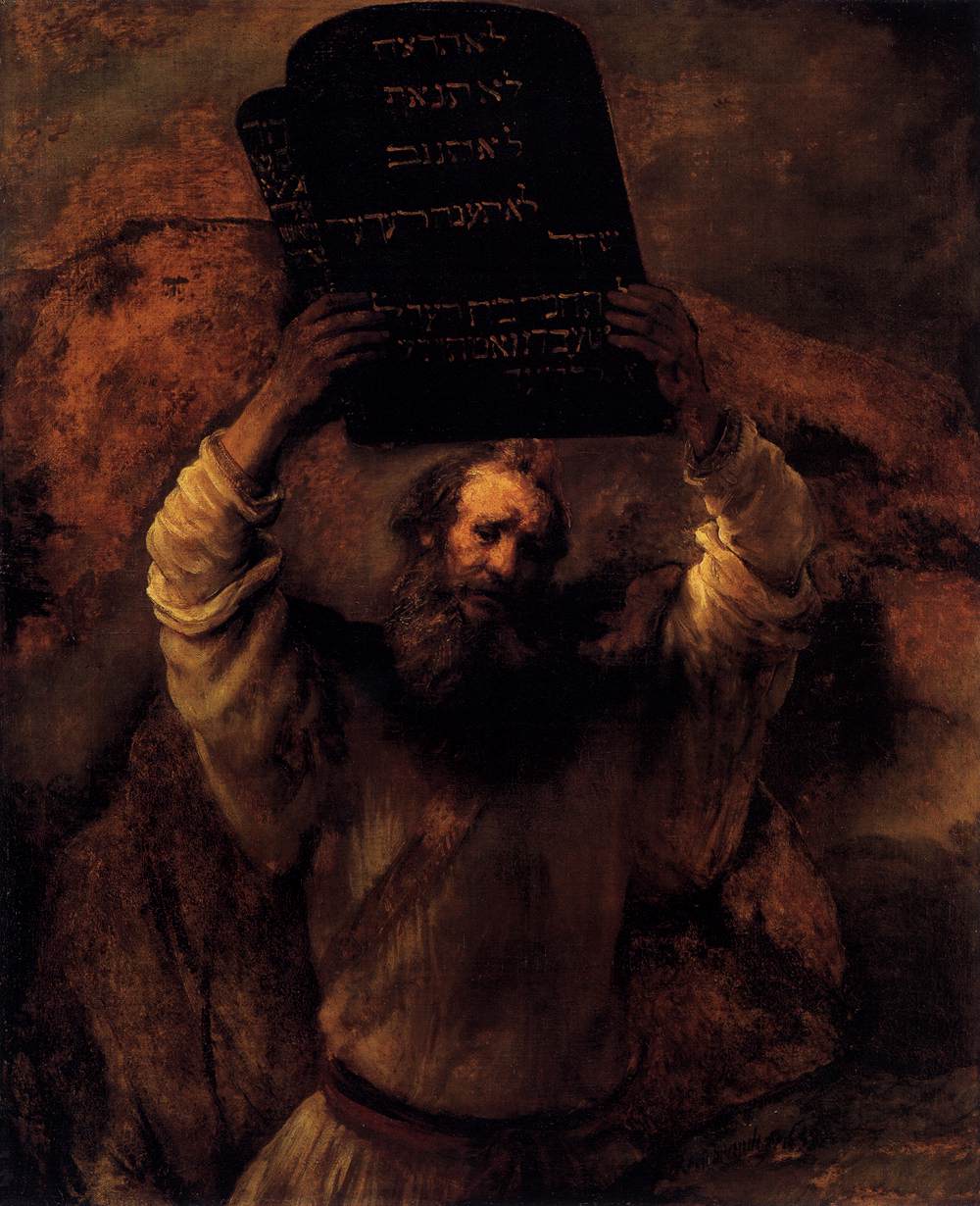 |
| Moses with the Ten Commandments, by Rembrandt van Rijn |
A COVENANTAL LIFE
Speaking of law, we must also speak of the structures of covenantal life. YHWH, the God of Israel is "bound" in a law-structured (torah-structured) covenantal relationship with His people.
The law is often viewed negatively at some parts of the Scripture. The book of Galatia, for instance, suggests that the law proves men’s need for the gospel due to men's incapability of fulfilling the law, according to Martin Luther. Yet in the Old Testament, especially in the book of Deuteronomy, the law is pictured as a beautiful, God-given grace to mankind, for the sake of a well-ordered community.
“More generally, these laws, both individually and in their entirety, are a gracious gift of God for the sake of life, health, and well-being of individuals in the community. This is made especially clear in the book of Deuteronomy. As Deut 5:33 puts it: these laws are given to God’s people “that you may live, and that it may go well with you, and that you may live long on the land that you are to possess.” God gives the law in the service of life. If for no other reason than that, they deserve our close attention” (Patrick Miller).
In Matthew 19, when the young rich man came to see Jesus asking what he must do to inherit eternal life, Jesus’ response was “Torah”. We could view His response from two perspectives. Jesus might intentionally make the young man aware of his incapability so he would be humbled, yet Jesus might have responded like so to make the young man live. Although, we do know the ending to that story and how the young man fell short.
Moreover, we believe in the three uses of the law. The first being pedagogical use, the law reveals the perfect righteousness of God and our own coming short of it (what Martin Luther emphasized on), the second being civil use, the law restrains evil through punishment, and we must never forget the third use of the law, that is as a normative use, the moral standards of the law provide guidance for believers as they seek to live in humble gratitude for the grace God has shown us.
Therefore, we must remember that the law also includes the rules and regulations to perform a sacrifice of atonement. Both the confession of sin and sacrifice of atonement must be done to avoid the pride of self-righteousness. Above all, we must never forget the third use of the law, that is the law as good news for those who have gained a new life in Christ.
THE CANON AND DEUTERONOMY
The book of Deuteronomy is an important part of the Pentateuch. It is located at the end of Pentateuch, being the closure of the five books of the law, and it also precedes the books of the prophets, which begins with the book of Joshua. As a closure to the Pentateuch, Deuteronomy recalls all the promises given to the ancestors of Israel, it retells the grand stories of the exodus and the events experienced by the ancestors at Mt. Sinai. But the book also includes Israel’s entering into the promised land. Deuteronomy does not only recall the previous four books but also anticipates the entering to the promised land in the book of Joshua.
This implies that the revelation of the law is not a once-and-for-all matter, but integral. The events that had happened, happened prior to Mt. Sinai, but the stories were retold according to the contextualization of the newer generations, time and places.
THE CENTER OF DEUTERONOMY
The main theological points of the book of Deuteronomy are:
- The suppression of idolatry
- Centralization of a worship place/cult centralization
- Renewal of the covenant


